

Awareness and Simulation
Blessed are the beasts that run across the savanna, unaware of their own existence.

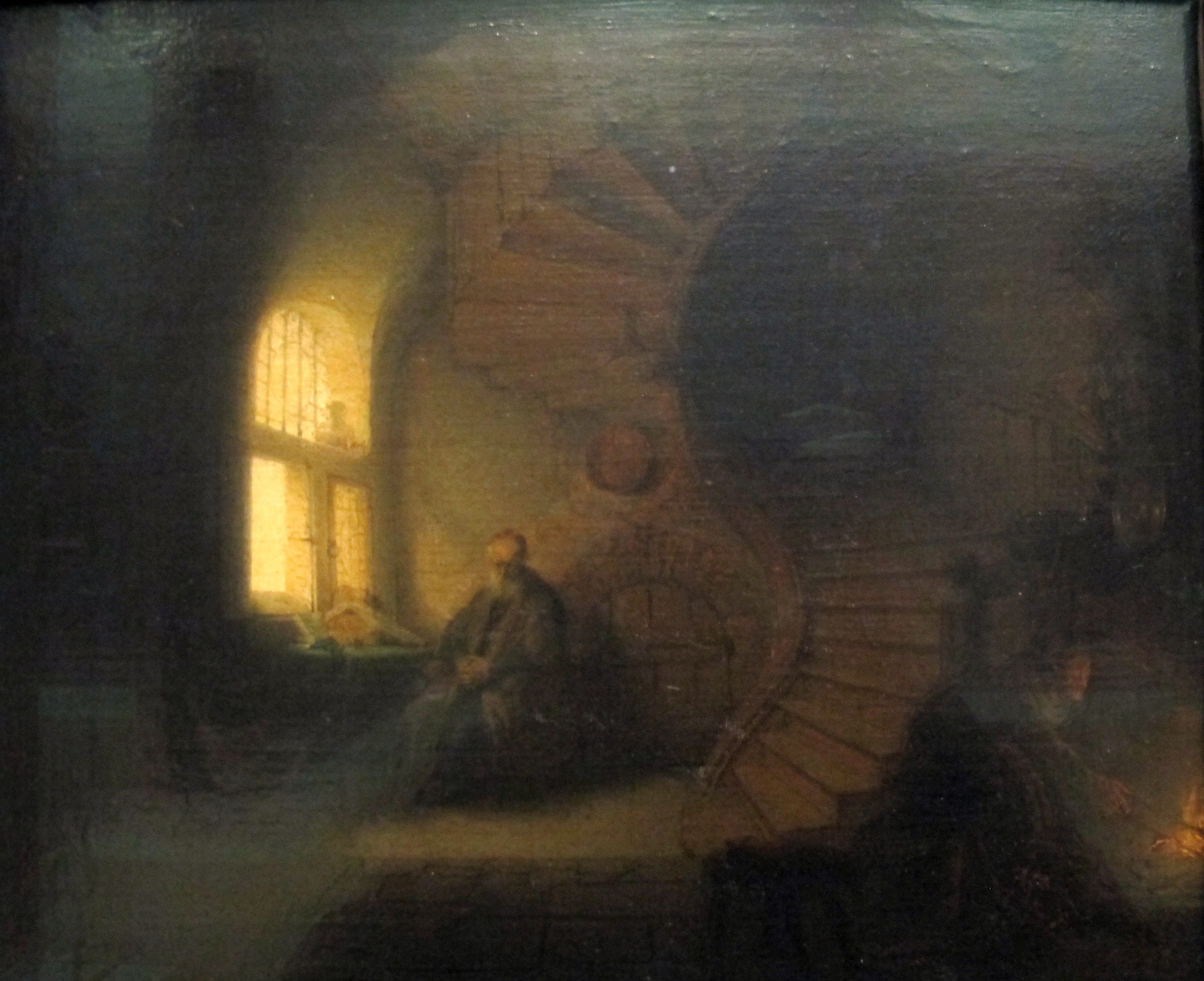
Image: Rembrandt van Rijn, Philosopher in Meditation (1632), Musée du Louvre. Public domain. Source: Wikimedia Commons.

The only common thing about all existing things is existence itself. Yet, only one species contemplates its own existence.
Blessed are the beasts that run across the savanna, unaware of their own existence. Blessed are the fish who, oblivious to the water surrounding them, don’t have treacherous thoughts of leaping out to “see what’s out there.” Lucky are the chrysanthemums that blossom and die in the same place, their roots grounded deep in the soil, their petals smiling at the sun. And happy is my dog, who sits beside me on the sofa, unaware of the larger reality in which he and I exist.
Unlike other creatures, human beings have the capacity for self-reflection and for grasping abstract properties, such as freedom, justice and the color blue. We do not merely encounter the world as a series of stimuli, but can step back from our experiences, name them, and ask what they mean. In knowing particular things, we not only learn about the things themselves, but also become aware of ourselves as knowers. This ability to reflect on our own existence stems not only from our intellect, but from a deeper sense of awareness and presence in the world.
“I think, therefore I am.”
Descartes’ statement has become the curse of our modern age, reducing the human person to intellect alone and casting aside presence and awareness as secondary or inconsequential. Is my existence, my essence, defined by my act of thinking? Doesn’t a baby, who has not yet fully developed her intellect, still exist? Doesn’t my dog exist, even though he lacks the capacity to reason? If I am in a coma, and all my power and will cease along with my ability to reason, do I no longer exist? Of course not. No one would argue that a person in a coma is no longer a person. Such is the absurdity of our rational age.
That is why people mistakenly believe that Large Language Models (LLMs) and other AI systems are “beings.” “It thinks, therefore it is.” Agency is not the same as existence. Reasoning is an attribute of my being, but it is not my being. When I am asleep and thinking of nothing, I still exist.
Is AI really intelligent?
AI models are merely prediction machines. Such models are taught to predict the next word in a sentence, the next image in a sequence, the next behavior in a pattern. The same way I teach my dog to jump through a hoop in exchange for biscuits, engineers train AI models to predict and perform rule-based inferences by feeding them large amounts of data and positive reinforcement. However, the fact that a machine can predict and appear to make inferences does not mean that it possesses knowledge, much less that it “is” an agent.
A machine lacks presence, the state of being fully conscious and aware in the present moment, connecting its inner essence with the outer experience. A machine is incapable of immersing itself in the present moment to experience what the moment has to offer. What we perceive as agency is the machine providing super-fast output based on a given input. What we perceive as intelligence is the machine’s superspeed computation of an incredible amount of data, without a real understanding of the actual meaning of that data, given its inability to relate on a deeper level to the world outside itself. The machine has derived agency, but no soul.
The tragedy of our times is that we reduce the human person to a single faculty, reason alone, and confuse the operation of a faculty with the act of being. According to Saint Thomas Aquinas, the human being is one substance composed of body and soul (hylomorphism). In this view, the soul is not a ghost inhabiting a machine, nor is the body merely instrumental. Awareness arises from this unity, through the soul as the form of the body, not from soul or body in isolation. As Aquinas writes, the soul is “that by which we live, sense, move, and understand” (Summa Theologiae I, q. 76, a. 1).
To Aquinas, all knowledge begins with the senses (nihil in intellectu nisi prius in sensu), and sensation is not mere data intake but a formal reception of the world. The knower becomes intentionally present to the known object. Therefore, for Aquinas, presence is not mere physical location, but intentional presence. Aquinas goes further to argue that human persons uniquely possess intentional presence in an intellectual mode, as we can be present to realities that are absent, abstract, or immaterial (such as justice, God, and numbers).
Machines are fundamentally different than humans. Computers and AI models are simulations of the human mind and have form only extrinsically, from the maker’s intention. An AI system has no soul (neither vegetative, sensitive, nor intellectual). It is not a unified substance (organism) but an aggregate of parts. Therefore, machines and AI systems do not understand, do not know, and do not experience presence.
For Aquinas, understanding involves grasping intelligible forms. This act is immaterial, since universals are not material things. Machines manipulate symbols physically and operate entirely at the level of efficient causality and prediction. They possess no intrinsic intentionality, only behavioral imitation, which does not constitute intellect. The machine is therefore nothing more than a simulation. Any apparent awareness an AI seems to possess is analogous to a mirror reflecting an image, not a mind knowing an object.
Human awareness and presence, for Aquinas, are grounded in a rational soul that cannot be reduced to mechanisms, no matter how complex. In that sense, AI is a powerful artifact that extends human agency, but it remains ontologically closer to a tool than to a person.
The tragedy of our time is not that machines are becoming more human-like, but that humans are reducing themselves to the level of machines. In doing so, we forget that we are living unities of body and soul, endowed with intellect and capable of intentional presence. In our pursuit of efficiency, we risk exchanging genuine awareness for its simulation, and in that exchange, we diminish our own participation in what it means to know, to be present, and to be human.